Showing posts with label Parental Leave. Show all posts

Thursday, 29 September 2016

What is Parenting Worth?


At a recent Q&A event, I shared the aims of The MaternityTeacher PaternityTeacher Project with two separate audiences, and on both occasions was challenged by mothers who wanted to see society placing more value on the importance of parenting.  They seemed frustrated by the idea that doing more than parenting on maternity or paternity leave was necessary to prove to employers and colleagues that a candidate was more than just a parent because - and I wholeheartedly agree with them - parenting is the most important role in our society.

Now this is a tricky thing to criticise because a very simple version of what I'm about to say is that as a country, we don't do parenting very well.  This is, of course, not true - there are millions of caring, loving, nurturing parents up and down the country doing a fantastic job at raising their children.  When we begin to compare the system that surrounds this parenting with systems like those in Scandinavia, for example, though, it is easy to see that parenting well in the UK is an uphill battle: child development experts say that children need love and attention from their caregivers, and there is increasing research into the positive impact of 'stay-at-home' dads, yet my own (fairly generous) maternity package has me cringing at the end of three months, and if my husband was a British citizen and wanted to take his share of parental leave, he'd be bringing in a whopping £137.50 a week - a budget that, in London, would leave us homeless.

Now I want to go back to work, and am sufficiently in love with my career to do so, regardless of the financial cost, but the fact is that if both my husband and I want to have careers, we have little choice but to put our son into childcare, even though the many, many pieces of research that I have read, tell us that this is possibly not the best thing for him due, in part, to the lack of flexible working hours and creative thinking around making work work for parents.

Not only is it logistically difficult to parent well in the UK, there is a dominant culture that sees maternity leave or paternity leave as time 'off'.  In the same breath, I have heard school leaders shudder at their own memories of sleep regression before envying parents their time to 'relax' away from the classroom, which seems to be a confused response, but one that seems to be broadcast by society.  No matter how difficult or easy you find parenting a small baby, it is telling that society considers parental leave as a bit of a holiday - time to do all those things you can't do whilst you're at 'work'... but... surely the definition of 'work' is that which contributes to and supports and economy and a society, and what 'work' is there that does this more than parenting?  As a parent, therefore, shouldn't I be perceived as working hard to improve our society by raising a kind, thoughtful, generous, polite, proactive, educated child?

So are we all just taking a bit of a laissez-faire attitude to parenting, because society is telling us that we are on holiday, rather than reminding us that we have just been promoted to one of the most important jobs in the country, or are we working are socks off to be great parents, and then humbly playing down our achievements because nobody has given us a certificate, and the world of work doesn't see the worth of what seem like highly valued and transferable skills like communication, empathy, multi-tasking, prioritising, educating...?

We've once again come around to the question of revolution vs. evolution: should we lobby for a social revolution that values parents more highly, or should we push upwards by providing society with a clear model of how things might be done better, and by quietly proving our worth by getting on with things now?

If you've read any of my other posts, you'll know that I'm all about doing and doing now, so how about this for solutions-focused thinking: as a parent who gets paid for being a teacher, you are automatically a MaternityTeacher or a PaternityTeacher because from the minute you take an interest in the development of your child or bump, you are learning new things.  Unlike a lawyer or an accountant or an engineer, this is learning that directly translates to the classroom, because your clientele are children, and understanding a newborn baby gives you phenomenal insight into the behaviours and needs of an older child or teenager.  In fact, as a parent, you are simply an 'unqualified' EYFS teacher - a paid, respected career.

So if 'all' you want to do on parental leave is be an amazing parent, and are frustrated that this won't be valued when you return to school, then why not make society's indicators of value work for you: namely, get a certificate and intellectualise your role as a parent.

Now, this might sound like energy that you would rather be spending on your child, but the beautiful thing is that it is energy that you are spending on your child, you are just being smart about it.  The construction of my son's play arch is a perfect example of this, but allow me to give you another example: nursery.  Every parent knows the long and slightly anxious process of finding the right nursery.  Initially, for us, our main priority was cost and bilingualism, but I noticed that there appeared to be different 'types' of nursery, and one that seemed popular was the Montessori approach.  I'd heard of Montessori but I didn't know much about it, so I ordered a book.  Already, I'm doing CPD.

Once I'd read the book, I realised that Montessori wasn't just about Early Years - there are many things that can be taken into the secondary classroom:

  • Child-centred environments - creating classrooms that students can access; that are beautiful and appeal to all of the senses; that encourage independent learning, curiosity and confidence; label resources in a uniform and clear manner to support independence in all learners, including those with SEND.
  • Competence and responsibility - creating responsible young people by assigning roles that help the lesson to function - handing out books, recording house points, rubbing the board, handing out glue sticks and work sheets, opening blinds, updating displays - roles that are both empowering for the student, and which also make life easier for you as a teacher!
  • Observation - watch the students first and understand what it is that provokes certain types of behaviour before trying to jump in to fix things: a perfect approach to peer and mentor observations.
As a mother, reading this book at five weeks was CPD: it revolutionised my parenting in a way that none of the baby books had.  I stopped forcing my solutions on my son, observed his behaviour for a few days and understood his cries, his needs and his patterns far better, which allowed me to work with him, rather than despairing at this unreasonable, incomprehensible little being.  

As a teacher, reading this book was... CPD! and I did the same thing with Rug Rhymes and early reading; concerts and art galleries and sensory understanding; Oprah and early language acquisition; the OPOL approach, EAL students and inclusion.  Essentially, intellectualising 'good' parenting so that those who are ignorant of how important parenting is, are more impressed by what I am doing.

Learning more about child development can be hugely satisfying as a parent.  My teacher brain is constantly fascinated by the new things that my son learns, the way he interacts with his environment, how quickly he changes and makes progress - how his brain grows and learns!  And you know what, the more I see him learning, the more I want to learn about how he is learning and how I can help him to learn more, and this is nothing more than pedagogy - teaching!


If this is something that gets you really excited too, then stop defending your decision to 'just' parent, and embrace the fact that parenting is CPD, and get a certificate that you can wave in your Principal's face by completing one of these courses:

The Wider Impact of The MTPT Project

Recently, I have been challenged to make the connection between the benefits of The MaternityTeacher PaternityTeacher Project to an individual teacher, and the way in which the project - if it became a movement for social change around the 'issue' of parental leave and the education sector workforce - could make a wider impact.  What follows is a short essay, collating some of the relevant research I've been able to complete:

Research from the National College for School Leadership demonstrates that ‘School leadership is second only to classroom teaching as an influence on pupil learning’, and the Sutton Trust report on teacher impact shows that ‘The effects of high-quality teaching are especially significant for pupils from disadvantaged backgrounds.’

The UK is currently experiencing a teacher retention crisis, meaning that students across the country, including those in challenging contexts, are not receiving sustained quality teaching from a stable and secure workforce.

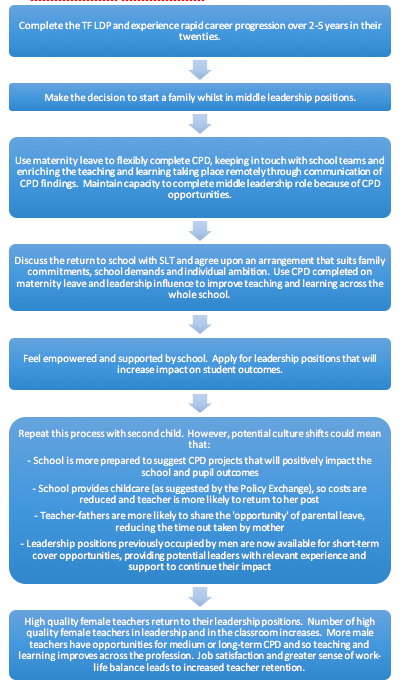
Research completed by the Policy Exchange and the IFS suggests that maternity leave is one contributor to this crisis, and statistics from the Future Leaders Trust regarding the disproportional number of female school leaders, and the low numbers of female senior leaders who are also mothers, indicates the long term consequences of women of childbearing age either leaving teaching, reducing their working hours after the career break represented by maternity leave, or lacking the capacity to apply for or sustain leadership positions either because of, or whilst supporting, young families.  Figure A appears to be the norm for a significant number of female teachers deciding to start families, using a typical Teach First participant/ ambassador to highlight the link between The MTPT Project and educational disadvantage.Complete the TF LDP and experience rapid career progression over 2-5 years in 

Figure A: a typical cycle for a female teacher in a 'challenging' school.
70% of Teach First’s 2016 cohort are women, a trend that perpetuates through the ambassador community with more than 5,000 female participants and ambassadors in total.   40% of Teach First’s current head teachers, and 62% of the attendees at a recent Senior Leaders retreat were women, all of whom will potentially be detrimentally affected by the career break and ensuing consequences of maternity leave.

In short, maternity leave is potentially removing a significant proportion of high quality teachers, current and potential leaders from schools that need them the most, having a negative impact on the outcomes for disadvantaged students.  For many female teachers working in schools that serve low income communities (i.e. a typical Teach First participant or ambassador) Figure A represents their contribution to the teacher retention crisis.

The MaternityTeacher PaternityTeacher Project aims to tackle this retention crisis by acting upon the Policy Exchange’s suggestions that the teaching profession embraces ‘more flexible ways of working not just within individual jobs, but across a longer time period’ by offering ‘subject knowledge enhancement’, ‘the chance to keep abreast with development’ and ‘specific short course to bring [teachers] up to speed’, in short, relevant CPD opportunities that will enable teachers returning from parental leave to continue to offer high quality teaching and leadership and to be valued by schools for doing so.

Figure B shows the ideal 'success story' of The MTPT Project:

Figure B: an MTPT Project success story.
In the long term, The MTPT Project could also reduce the number of teachers leaving the profession permanently by offering an alternative solution to teachers wishing to start a family: rather than suffer the stress and disillusionment that is often the cause of poor teacher retention, shared parental leave could be maximised to provide an opportunity for teachers of both genders to step out of the classroom whilst continuing to develop skills and knowledge that will contribute positively to the teaching and learning, and leadership within ‘challenging’ schools where teacher burnout rate is high.


Tuesday, 27 September 2016

Comprehensive Teacher, Grammar Mother

Over the last couple of years, I have noticed an increasing number of friends and acquaintances insisting until they are blue in the face that as a teacher, I must be interested in politics and I must have an opinion on things.  Until quite recently, I have been quite happy to reply that no, in fact, as a teacher I must be interested in Shakespeare and I must have time for planning and marking, and after that I must have time for a rest and a sleep and a cup of tea, and in between all of that very concrete stuff, I don't have time for any more abstract musts.

Brexit, however, changed quite a lot of that.  The result of the referendum came on the morning I went into labour and my little French-British son was born into a country that seemed to be pretty unwelcoming to half of his identity.  Suddenly this very abstract concept of politics was very personal to me, and the same thing seems to be happening with this whole grammar school debate.

Let me outline my position to you in brief: I am a Teach First ambassador and, unsurprisingly, therefore a big socialist.  I adamantly believe that a free education can be an excellent education because I had one.  As a trainee teacher in a 'challenging' comprehensive school surrounded by grammars, I also experienced first hand the damaging nature of selective schooling on both children as people and children as data sets.  My teacher head therefore knows that the UK would be a much better place for our children if there were no private schools and no grammar schools.

As a mother, however, my thoughts are completely different.  I don't like to think of myself as a hypocrite, but given the options in my area of private, grammar or struggling comprehensive, I'm going to pick what is best for my bilingual, literate, gentle baby.  Grammar, it is; hypocrite I am, and shamefacedly I contribute to what my politically informed friends are calling 'The Tragedy of the Commons'.  Oh dear.  My problem is that I want an enriched, French horn-playing, sailing club, Latin-lesson education for my son, but my local comprehensive can't offer this.  The tragedy is, that as long as parents like me who want this kind of education for their child are sending their babies to grammars and private schools, my local comprehensive will never be able to offer this.  By choosing what is best for my child, therefore, I am perpetuating a culture that I despise.

This MaternityTeacher is not about sitting around feeling ashamed about her own hypocrisy, however.  This MaternityTeacher is about grassroots action and bottom-up change-making, so I have thought of the most genius solution that would mobilise and empower not just the MaternityTeacher PaternityTeacher community, but parents on leave all over the country: as a parent, if your local comprehensive school doesn't offer the type of things you'd like your child to experience in 11 years time, then why not use your skills to do something about it and build the educational culture that you want for your child?

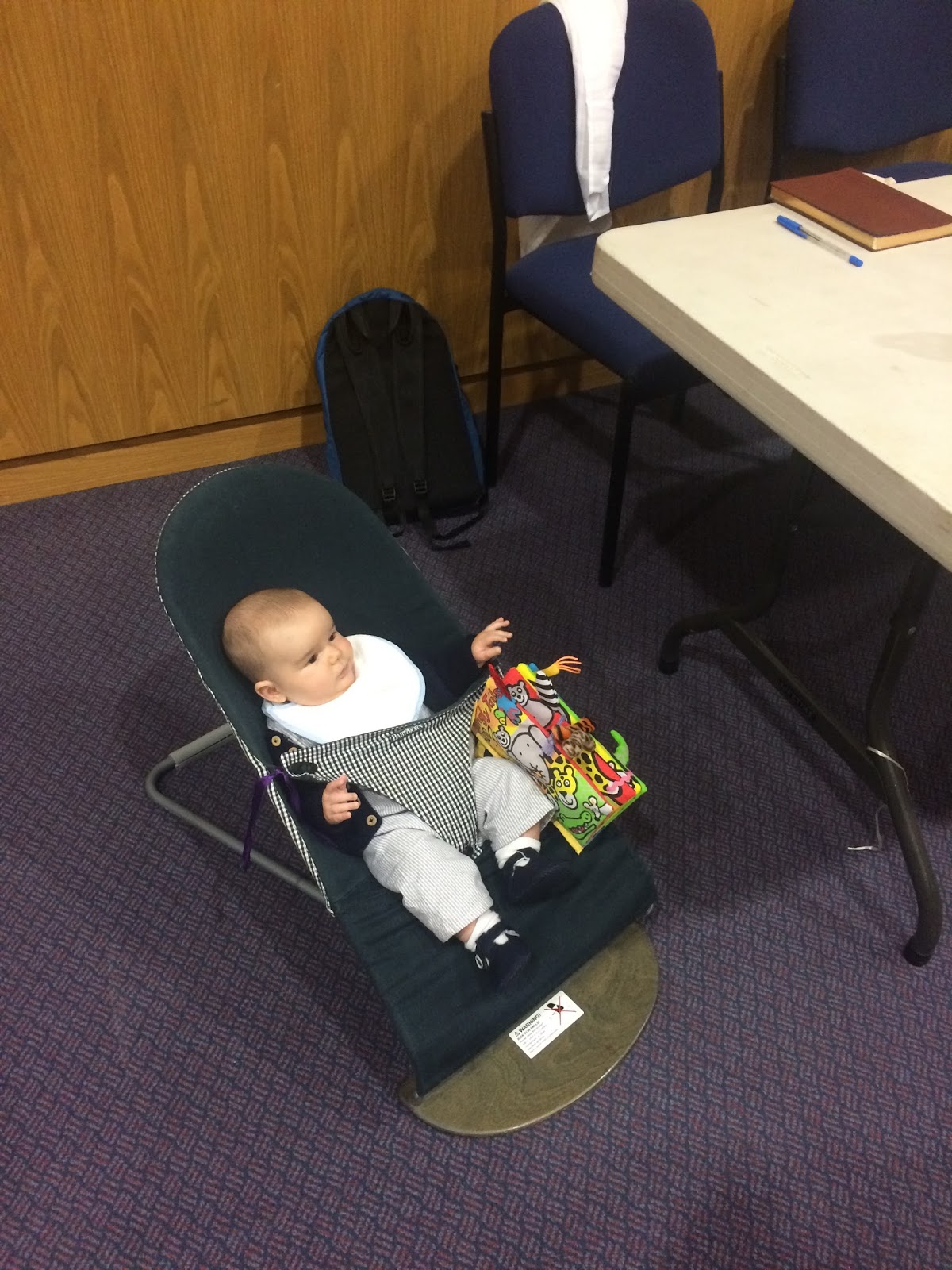
For example, I am a classically trained musician and I want to send my son to a school with an orchestra and a choir.  The music department of my local comprehensive school, however, has only been operating for six weeks, and does not have the capacity for extra-curricular clubs at present.  Why don't I, therefore, volunteer once a week to run the choir?  Whilst I'm at it, why don't I see if the school will let me take my son with me for this hour so that he absorbs all this music making from his bouncer?

If other parents on leave in my area did the same thing, then our local comprehensive could look exactly as we want it to for our children: rugby club on a Wednesday, string group on a Thursday, book club on a Monday, sailing club on a Friday, DofE trek at the weekend.  It might be eleven years until our own children would benefit from this, but if, when we go back to work, another parent takes on the project that we have started, then the cultures that we want will be well-established and we will have a school that not only rivals the local grammar and private options, but a school that has made a sustainable and positive impact on our community.

There's no denying that any school-based volunteer work is great CPD, so is this kooky commune thinking, or is this actually a really good MaternityTeacher PaternityTeacher opportunity?

Monday, 26 September 2016

MTPT Events

The MaternityTeacher PaternityTeacher Project really has gained momentum in these last few weeks, and with momentum comes events. I've tweeted about all of these, but wouldn't it be useful to have all the information about upcoming events all in one place? Well, your wish, MTPT community, is my command...

The WomenEd Unconference: 'Making the Most of Maternity Leave'

Please note: this is a ticketed event and is now sold out. However, if you have a ticket and are attending, here are all the details. If you don't have a ticket, please see below for ways to access the event remotely, or for other very similar forums, including other WomenEd events. 

Date: 8th October
Time: 10:30-11:15am

Blurb: this workshop will tell the story of The MTPT Project and outline its intentions. We'd really like to hear feedback from all interested parties - parent-teachers, SLT, CPD providers, future parent-teachers, whoever! - to support the development of the project.

Remote access: a very thoughtful man named Leon Cych has written an entire blog post dedicated to teaching me how to Live Stream. I'm on the hunt for equipment and will tweet the link if I get it up and running. If you haven't got tickets, please do still contribute to the discussion with the hashtag #MTPTproject and #WomenEd. The official MTPT Twitter handle is @maternityCPD. 

If I can't upskill in time, I will video the event and upload it somewhere convenient. 

Childcare: WomenEd are happy to provide childcare but have apparently not had any requests for it so you'll have to get in touch with them if you'd like some last-minute arrangements. They are very welcoming of families so don't hesitate at all about getting in touch. My 3 month old will be in a sling or a bouncer for the whole session so if you'd like to bring your children and any of their infrastructure, please do so. I am very excited at the prospect of a very loud and dribble-filled event!

Teach First London Conference 1: Discussion: Teaching, Parenting and CPD

These conferences are mostly attended by first and second year Teach First participants, but all the sessions are open to Teach First ambassadors and anyone working in a Teach First school so if this is you, come and take advantage of a whole day's worth of free CPD. As an ambassador, all you have to do is sign up to sessions on the community website. If you're not an ambassador, either use the Teach First channels in your school to get signed up, or get into contact with me (e-sheppard@hotmail.co.uk). 

The MTPT Project forum is open to anyone who's interested, whether you have affiliations with Teach First or not, but you'll have to let me know in advance so that I can create a guest list for fire safety and probably insurance reasons. Use the email address above, or the Twitter handle, @maternityCPD.  

Date: 24th October
Time: 3-4:30pm
Location: Lilian Baylis School, Vauxhall, London

Blurb: I'm anticipating a different audience for this event so the forum will repeat the structure of the WomenEd workshop.

Remote access: hopefully I will have figured out and organised equipment to live stream by this time, so will tweet the link.

Childcare: because the majority of Teach First's attendees at these conferences do not require childcare, it is not offered - something that might start to change as the ambassador community (quite literally) grows.  Again, my son will be with me during the workshop, so please feel free to bring your little ones and any equipment they might need.

Teach First London Conference 2


Date: 12th November
Time: 13:45-15:15
Location: Regent High School, Kings Cross, London

Blurb: this will be the first session focusing specifically on empowering and inspiring MaternityTeachers and PaternityTeachers, directing them towards the support that will help them to achieve their CPD goals.  If you are thinking of starting a family, if you or your partner is currently pregnant or on parental leave, then this workshop is aimed at you.  

We would still like to hear stories from former MaternityTeachers and PaternityTeachers and any input from SLT, CPD Providers and interested parties who have not been able to attend previous events.

Remote access and childcare as above.


Wednesday, 21 September 2016

Q&A + Baby

This is white noise in the corridor calming him down.
Today, baby and I faced our biggest professional challenge yet: appearing as panellists at the Teach First annual offsite conference for Teach First employees and partners. This meant two 60 minute Q&A sessions in Nottingham (I live in London) exploring the ideas behind The #maternityteacher Project and achievements to date.  This required a lot of energy, and our smartest pair of shoes, but I found that repeating motivational mantras to myself gave me the encouragement to get up and go. 

"I am the change I want to see in the world," I said to myself when I got into the shower at 6am. Baby farted in his sleep and sighed in a satisfied way. 

"Be 10% braver," I said to myself whilst getting baby up and changed. Baby pooped all over the changing mat three times. Clearly very excited, maybe a bit nervous about his guest appearance. 

"Coffee is always a good idea," I said to myself as I left the house with a Baby Bjorn bouncer frame over my shoulder like Huckleberry Finn's mum, to join the 7am commuters. Baby stuck his tongue out to suck up the tube breeze and dribbled. 

"I am a super woman," I said when my train was cancelled and I approached station staff to request to be re-routed. Baby chewed his whole fist and sicked a little down his chin. 

"Thank fuck I don't have to do this every morning anymore," I said as I put the bouncer frame in the luggage rack and released baby from the sling. Baby pooped loudly and smiled. Achievements come in many varied forms. 

Note: professional shoes.
When we finally got to Nottingham, the panel itself was very exciting, if a bit overwhelming. In true #maternityteacher style, we arrived a million hours early, reconnaissanced the room, set up the bouncer, had a feed and a cup of tea and finished the last chapter of 'Jungly Tales' by gumming it aggressively before the first audience members arrived and baby became an instant sensation.  

Now, here's a tip if you're considering doing a similar event with your baby: your baby is the most beautiful little person in the whole world; he is making an appearance at an event where babies do not usually appear; everybody loves an adorable, smiling baby, and everybody wants to touch said baby.  I'm normally very happy and proud to hand my baby over to other people for cuddles - often I take pictures of him with various professional celebrities - but I was surprised at how worried I was that he would be overwhelmed by all of this attention, and yet at the same time I would have been offended if he had been ignored!  This was probably a projection on my behalf, but something to think about if other people touching your baby is not your favourite thing.
Yes, my baby is PERFECT.

Once I'd calmed down my inner control-mother, I delivered my introduction, realising that I was the only one who had brought notes.  Part of me felt like a school girl rather than a serious, professional person; the other half of me got flustered and distracted when the baby screamed about his wind so was very grateful to have a set of bullet points to follow whilst most of my brain was actually worrying about him.  Use whatever personalised strategies allow you to multi-task in this way, even if they do make you feel like you're laying out your shiny new pencil case on your desk on the first day of school.

After all three panellists had spoken on different aspects of women in leadership, there was an explosion of responses that I am going to have to take a whole day in my pyjamas to process.

Amongst the ideas that stood out was the importance of choice. Whenever anyone starts talking about parenting, discussions become very personal, very charged and very defensive. Am I doing enough? Am I doing it right? Have I met expectations? Am I a good mother? Am I a strong woman? One thing I maybe didn't emphasise enough today was that the inception of The #maternityteacher Project was motivated by fear: I am bad at doing nothing; boredom scares me; I have to build structured relaxation time into my day so that I don't feel guilty; I was deathly afraid of getting post natal depression because of such a dramatic shift in my pace of life. I couldn't find any examples of parental leave that didn't include Baby Jazz or baking, and these things don't float my boat half as much as improving my understanding of 19th century literature or facilitating a session on EAL for trainee teachers.  


Note: engaged speakers, vacantly staring mother.
It was really interesting to see and hear how the idea of The MaternityTeacher PaternityTeacher Project was received by a whole range of parents - from those who had told their Mums that they were going to complete PhDs whilst on maternity leave, but had ended up happily lying on a beach for nine months, to those who thought that the responsibility for bridging the gap of parental leave lay in changes to organisational structures, not programmes of 'catch up' like this one.

This raised the question of revolution vs. evolution. Do we need a social revolution that completely changes the way that we perceive parental leave, women and men's roles, and childcare? That makes certain gender-focused events obligatory for men or maternity leave coaching a legal requirement for all organisations? Or will the only effective change be a result of a trickle down effect whereby this #maternityteacher supports and inspires three other #maternityteachers and #paternityteachers who go on to inspire nine more... until eventually there is no need for a revolution because organically, there will be a more even balance in the education system (and who knows - the whole country) between the sharing of parenting and leadership roles?

My personal, and very self-centered response to the evolution vs. revolution question is one of time: I have three months left of my maternity leave and if I wait for a revolution, I'll end up sitting in a classroom three days a week at 52, sipping my bitter coffee, reflecting on the career opportunities I sacrificed in order to raise three boys who were now contributing to the hateful patriarchy.  As it is, I am bored now. I am acting now. I hope to inspire and support now. I'll leave all this talk of revolution to my French husband. 

Another interesting suggestion was that schools are awarded with a sort of 'Gender Equality' award, a bit like an Arts Smart or an Eco Schools Award that recognises the efforts made to ensure gender equality amongst staff and to teach these values to students in schools.  I'd have to get my head around this one and the dangers of positive discrimination and tokenism vs. meritocracy, but I thought it was a creative idea to suggest, which could have some potential. 

A final resounding comment came from the only man in the first session: it had been intimidating and uncomfortable to attend the event as the only man in the room but it had been important, relevant to him and very interesting. At lunch time, he and others who had been at the first session actively sought out other men and said, 'You should go to this Q&A panel after lunch. This crazy woman has brought her baby.'  After lunch, there were at least ten - maybe more - men in the room. They were all interested, they were all engaged.  One of them sadly reflected that he had missed the opportunity for a cuddle, now that the baby was asleep in the sling.

It was so exciting to hear from Team Dad and have my suspicions confirmed: we are all on the same page here. Time away from the office/ classroom to spend with your child: good. Flexible CPD to develop your skills in areas of interest or reflect on career pathways: good. Shared childcare responsibilities that means everyone gets to enjoy magical smiles and dribble: good. Greater equality in educational leadership: good. None of this is exclusive to one or other gender. So encouraged am I by this that I'm changing the name of this Thing to The MaternityTeacher PaternityTeacher Project.  It's longer, but The ParentalTeacher Project sounds weird.  I'm also going to keep asking for someone to put me in contact with a male teacher who has completed CPD whilst on parental leave to be my @paternityteacher partner in crime. Are you out there? Do you have Twitter?

Please zoom in to his facial expression here.
Amongst all of this excitement and intense chat, baby was mostly an absolute legend and at all other times he was a baby and did all the normal things that babies do. He got grizzly and needed to be bounced in the sling to fall asleep. He made noises (delightful) as if he were in the Houses of Parliament  during the other panellists' anecdotes. When he got wind and screamed, he had to be taken outside. I think it was too cold and we are not used to cold as it has basically been sweltering since he was born and he has spent most of his life in just a nappy, and he got clingy and didn't want to stay in the bouncer and chew on 'Jungly Tales' by himself. I've since realised that he is in the middle of an angry rain cloud on my Wonder Weeks app, but the only person who seemed remotely bothered by all of this was me. 

I had one brief moment of wondering whether it was all a bit too much and I was a terrible, selfish mother but then the baby massage elicited an enormous fart and suddenly baby was fascinated by his audience again (and then he fell asleep). 

We ended the day a little overwhelmed by all the potential and opportunity and relevance of the project and basically got home and collapsed and made vowel sounds to each other and smiled and dribbled some more. Nottingham is quite a long way for a small baby. Tomorrow we will do a lot of lying on the carpet and we might try to look for Spot the Dog again. We keep losing him. 

Tuesday, 20 September 2016

School Trips

Team #maternityteacher have just come back from our first family weekend away to the Peak District which was the most fun, and it got me thinking about how awesome parental leave is because of all the flexi-time it offers. On Friday, when all other teaches were in the classroom, baby, Frenchie and I were zooming up the M1 to the countryside, and I thought, 'Gosh, it's great being on maternity leave - I'd never be able to do all of this learning-outside-the-classroom if I was on full teaching timetable and restricted by contracted hours!'

Now, for anyone reading thinking that maternity leave is a holiday, it is not: this was not a mini break, this was a bonafide CPD school trip. Had I been on a full time pay roll, I would definitely have put in an expense claim - that's how linked to my teaching and learning practice this was, as it was inspired by my FutureLearn course, 'Literature of the Country House'.  The course includes excerpts from 'Pride and Prejudice', 'The Sylph' and 'The Mysteries of Udolpho', all which have links to Derbyshire in the form of that dramatic rock that Kiera Knightly stands on in the film; Chatsworth House, home to both Mark Darcy and Georgiana Cavendish (also Kiera Knightly), and Haddon Hall, the gothic inspiration for Ann Radcliffe's 'Udolpho'.

School trips like this absolutely count as CPD for the exact same reason that they count as learning for our students - they bring learning and texts and theory to life and make them so much more exciting; they develop soft skills like determination and organisation and confidence; they inspire ideas to bring back into the classroom, and they provide opportunities that teenagers and teachers both love for awesome, no-inhibitions, dream-fulfilling photos:


I am Lizzie Bennet.  This is her rock.  Jane Austen lives through me etc.

Having returned from this trip, for example, I am now completely convinced that I can accompany a DofE trek, a commitment I have previously hesitated over volunteering for because of a concern that I might not be outdoorsy enough - such things are for Geography and PE teachers, surely?  Well, not any more.

In a previous trip to the Sedgwick Museum of Earth Sciences in Cambridge, I spent about an hour pondering climate change and my insignificance in the gazillion-year-old scheme of things, and am now on the hunt for copies of the letters of Mary Anning, Darwin's diaries, Adam Sedgwick's letters and Thomas Hawkins' 'The Book of the Great Sea Dragons' to create a portfolio of Literary Non-Fiction and Literary Fiction like 'A Sound of Thunder' and 'Journey to the Centre of the Earth' to create a portfolio with a cool name like 'Dinosaur Hunters' that will make exam practice feel like a trip to the cinema to see 'Jurassic World'.

One thing, from a parental point of view, that has been really fun, has been basing these trips on whatever the baby is supposed to be doing, developmentally.  There's a point, for example, when babies go into sensory overload, so we went to Kew Gardens to smell (I learnt a lot about bees and want our Science Department to do a trip here), St. Martin-in-the-Fields to listen, the V&A to look at shadows (amazing STEM opportunities) and put our feet in the cold water of the courtyard pond, and Borough Market to eat all the free tasters.  When the baby started to make connections and appreciate patterns, we went to the Tate Modern with my Mum and I wrote a whole scheme of work on Shakespeare, dance and physical theatre.

What has also been fantastic about a lot of these London-based trips (I work in a London school), has been the opportunity to act almost as a travel agent for my Head of Department, letting her know about experiences that I have already tried and tested, and which would be suitable for different groups of students.  As a busy manager, she doesn't have as much time as she would like to get out, discover, research and test drive these school trips, so having someone who will do this for her - and have a lot of fun, cuddles and tea in the process - is a huge bonus for her.