Showing posts with label Leadership. Show all posts

Thursday, 29 September 2016

The Wider Impact of The MTPT Project

Recently, I have been challenged to make the connection between the benefits of The MaternityTeacher PaternityTeacher Project to an individual teacher, and the way in which the project - if it became a movement for social change around the 'issue' of parental leave and the education sector workforce - could make a wider impact.  What follows is a short essay, collating some of the relevant research I've been able to complete:

Research from the National College for School Leadership demonstrates that ‘School leadership is second only to classroom teaching as an influence on pupil learning’, and the Sutton Trust report on teacher impact shows that ‘The effects of high-quality teaching are especially significant for pupils from disadvantaged backgrounds.’

The UK is currently experiencing a teacher retention crisis, meaning that students across the country, including those in challenging contexts, are not receiving sustained quality teaching from a stable and secure workforce.

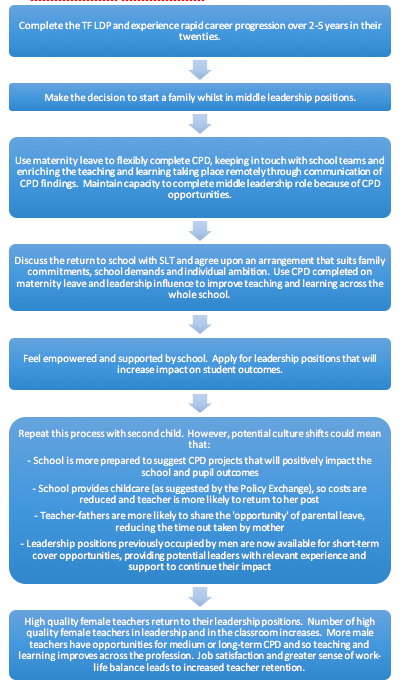
Research completed by the Policy Exchange and the IFS suggests that maternity leave is one contributor to this crisis, and statistics from the Future Leaders Trust regarding the disproportional number of female school leaders, and the low numbers of female senior leaders who are also mothers, indicates the long term consequences of women of childbearing age either leaving teaching, reducing their working hours after the career break represented by maternity leave, or lacking the capacity to apply for or sustain leadership positions either because of, or whilst supporting, young families.  Figure A appears to be the norm for a significant number of female teachers deciding to start families, using a typical Teach First participant/ ambassador to highlight the link between The MTPT Project and educational disadvantage.Complete the TF LDP and experience rapid career progression over 2-5 years in 

Figure A: a typical cycle for a female teacher in a 'challenging' school.
70% of Teach First’s 2016 cohort are women, a trend that perpetuates through the ambassador community with more than 5,000 female participants and ambassadors in total.   40% of Teach First’s current head teachers, and 62% of the attendees at a recent Senior Leaders retreat were women, all of whom will potentially be detrimentally affected by the career break and ensuing consequences of maternity leave.

In short, maternity leave is potentially removing a significant proportion of high quality teachers, current and potential leaders from schools that need them the most, having a negative impact on the outcomes for disadvantaged students.  For many female teachers working in schools that serve low income communities (i.e. a typical Teach First participant or ambassador) Figure A represents their contribution to the teacher retention crisis.

The MaternityTeacher PaternityTeacher Project aims to tackle this retention crisis by acting upon the Policy Exchange’s suggestions that the teaching profession embraces ‘more flexible ways of working not just within individual jobs, but across a longer time period’ by offering ‘subject knowledge enhancement’, ‘the chance to keep abreast with development’ and ‘specific short course to bring [teachers] up to speed’, in short, relevant CPD opportunities that will enable teachers returning from parental leave to continue to offer high quality teaching and leadership and to be valued by schools for doing so.

Figure B shows the ideal 'success story' of The MTPT Project:

Figure B: an MTPT Project success story.
In the long term, The MTPT Project could also reduce the number of teachers leaving the profession permanently by offering an alternative solution to teachers wishing to start a family: rather than suffer the stress and disillusionment that is often the cause of poor teacher retention, shared parental leave could be maximised to provide an opportunity for teachers of both genders to step out of the classroom whilst continuing to develop skills and knowledge that will contribute positively to the teaching and learning, and leadership within ‘challenging’ schools where teacher burnout rate is high.


Wednesday, 7 September 2016

Facilitating CPD + Baby

Yesterday I was absolutely delighted to return to school on the first day of the new year to deliver a CPD workshop to my Department on grammar.  This wasn't simply a lovely opportunity to see my colleagues, meet the new trainees and spend 90 minutes talking about verbs; it was also a significant #maternityteacher moment as it marked the first workshop I had been invited to facilitate with my baby.

When I originally sat down to think about the logistics of accepting the invitation, I was confronted with an anxiety-inducing list: what if the baby had a meltdown half way through the session forcing us to abandon ship; what if I let the Department down by being a bit frazzled and naff, trying to do too many things all at once - attend to baby, deliver workshop, smile, click on the next slide; what if I ruined my reputation in front of valued colleagues; what if everyone thought I was a total weirdo (and a Bad Mother) for bringing my baby into school when I was supposed to be at home, wading in the pink fluffy jacuzzi of motherhood?

I'm pretty sure that these types of thoughts are what the media means when they talk about the 'confidence gap', so if you are having them too, why not banish them with these helpful solutions-focused tips for facilitating a CPD session with a baby strapped to your chest?

1a. Know Yourself and Your Baby

The better you know what works for yourself and your baby (I suggest some Montessori-style observation), the more smoothly your session will run.

My baby, for example, does not do dinner dates because he is busy being possessed by the devil between 7:30-9:30pm, but between the hours of 8:30-4:30 he is an absolute delight as long as he is fed and bounced to sleep at the right times.  I am also lucky that he's already set himself a semi-regular routine of eating every 2-3 hours, burping, being awake and then sleeping for 20-40 minute intervals.  With this in mind, whenever I've planned any professional meetings, I've always given myself a good 30 minute leeway on timings.  It means that I arrive super early to things, but it also means that I have time to sit down, relax, feed, change nappies and burp him so that I can present the world with an apparently perfect child.  Then I keep a very close eye on the clock and...

1b. Prepare for All Eventualities

Whatever it is that settles for your baby, have it on hand, and adapt it for the logistics of your session.  Be it slings, bouncers, buggies, white noise, bottles, dummies, blankets - whatever it is, factor it into your workshop.

For me, this means bringing the sling with me wherever I go, and if I'm going to be anywhere for an extended period of time, then the bouncer, too, because the buggy just does not cut it for my little man.  At the beginning of this session, it also meant taking off a layer (hot classroom), being ready to strip baby down to his nappy (hot baby = furious baby), wearing an empty sling for 45 minutes until the first signs of fatigue presented themselves as predicted (and knowing what these are) and then getting baby into the sling as quickly as possible and doing a series of deep squats until he was sound asleep.  It also meant scouting out the most appropriate breastfeeding spot and keeping the clock in view.

Keeping a baby settled for a controlled period is not sustainable - at some point they're going to have an unpredictable melt down (baby cried aaaaall the way home from this session despite buggy + uneven ground) - but try to think of it like behaviour management: the better you anticipate a volatile child's needs and how they will react to outside provocation, the more likely you are to avoid said child kicking a chair, spitting in your face and storming out of the classroom.

2. Pick a Friendly Audience

My Department are lovely people and they know me well enough to know that I am completely bonkers and hyperactive.  As a warm up to the three other conferences I've committed to in the coming months, therefore, these guys were a safe bet: not only did my Head of Department immediately take me up on my offer to 'help out' whilst I was on maternity leave, she also ensured I was accommodated and welcomed throughout the whole afternoon.  I felt empowered and awesome as I delivered that session because five of the eight of my audience members had already met, held, and had my baby shart in their arms.

This level of familiarity will not always be the case, and facilitating an adult session is exposing at the best of times.  Doing so with your baby is a very personal choice.  Having friendly and supportive faces staring back at you who want to include or learn from you and who don't mind whether the baby cries will make the whole process an empowering rather than humiliating experience, and the more workshops you successfully facilitate, the more practice you will get, the more confident you will feel and the further the news will spread that you are capable of leading CPD accompanied by your baby.

If you're not sure whether your audience will be baby friendly, then just ask, and be super clear about your requirements: don't be shy about saying, 'I will breastfeed during the session in front of the whole world.  Boobs, boobs, boobs, nipples', if this will be the case - better to make that clear now than upset some people later and, in my experience, people - even the big guns organisations, will surprise you with their utter acceptance of parenting practicalities.

3. Normalise with Confidence

It is likely that your nice audience will be split into three groups: parents who have Been There and Get It; people who have come into regular and close contact with other peoples' children, and people who are not parents and have no idea what is normal and what is not.  Whilst the first two groups might cheer fondly at a successfully executed spit-up burp, and compliment the colour-coordination of your sling and your outfit, the latter may gag at the sight of a full nappy and break into an awkward hot sweat at the mention of breastfeeding.

What is great about the latter group, however, is that you can hugely influence their understanding of normal baby-manners because they have no other point of comparison, as long as you do so with confidence: flashing your nipple whilst breastfeeding at your Head of Department's desk as you wrangle about the difference between a compound sentence and a compound object?  Totally normal.  Bouncing up and down in deep squats with a baby in a sling whilst listening to model sentences?  Completely fine.  Changing a poopy nappy on a school desk whilst discussing changes to the KS3 curriculum?  So what?

If you feel that there is an expectation for parents to have childcare arrangements if they want to facilitate or attend a session like this, then let's apply basic logic to normalise this issue as well: most nurseries won't take babies until they are 3 months old; most mothers are not ready to leave their babies at nursery before this; there is a whole load of administration that comes with putting your baby in nursery - you can't just leave him there for a random day; not all of us have family nearby or partners that can step in to provide childcare on a week day; organising time away from a breastfeeding baby is as much of a logistical nightmare as just bringing him along with you; childcare costs money and so in a situation like this where the facilitation is offered pro-bono, the parent would be out of pocket, and even if you had the option of a free live-in mother to care for your formula-fed baby, childcare arrangements are a parent's choice and (ideally) should not be forced by the inflexibility of other agencies.

Phew!  Look at all those semi colons.

If for you, like for me, childcare is problematic, you've therefore got two options: stay at home and do CPD in some other way, or confidently go about your normal parenting routines whilst demonstrating Kung Fu Punctuation.

4. Feel Bad?  Don't Feel Bad.

Of course it has occurred to me that I might be a very selfish mother for wanting to continue my professional development whilst on maternity leave.  Sometimes, when I am blogging, or answering emails whilst bouncing baby in his bouncer (God bless that bouncer), I feel guilty.  I should be playing, I think, and then I spend the whole afternoon making Nielsen Washing Baskets and kissing my baby and then I lie down on his mat with him, exhausted.  For more about the shitty guilt fairy that accompanies parenthood, read this very amusing blog.  For more about all the favours you are doing your child by being yourself, continue reading this blog...

I've done my research.  I have a fairly clear idea about what babies need to flourish: food, love, sleep, stimulation - in no particular order - but instead of signing up to Sensory Class and Splashy Tots, I'm walking my baby into work and asking him to sit quietly whilst I deliver a session on integrating grammar into schemes of work.  So let's be serious teachers and have a look at how this actually pedagogically benefits baby in the same way as an £15 an hour Baby Yoga Class:
  • We walk into school, we walk back from school.  On the way, we get fresh air; we look at the clouds and the lights coming through the leaves in the trees (great contrast and pattern); we listen to the traffic (soothing); we sing a song (no inhibitions); we hear a dog bark and other children squealing in the park; we feel the breeze on our faces and we smell a whole load of things from the rotting fish in the chip shop bin to the lavender on the National Trust estate.  Sensory Class.  Done.
  • We chat with colleagues at reception and over lunch, during which, at least a dozen people engage for at least four minutes at a time with baby.  He has the exclusive attention of cooing and tickling and baby talk and imitation of facial expressions from lots of different people.  He sees new faces and hears new sounds.  He smiles.  He gets lots of very high-stimulation attention - more than he gets from me, and everyone wants to try out their keys, their hair, their jewellery as new toys for him.  He learns to be social and gets lots of cuddles... I'm pretty sure that's good for both his immune system and his secure attachment.  Mums and Babies Class.  Done.
  • We deliver a CPD session on grammar.  He hears a lot of adult, literate conversation and soaks up all this wonderful language learning.  He lays down the foundations for a broad and developed vocabulary that surpasses Spot the Dog.  There are new smells and colours and textures in the classroom.  He gets to sleep in a sling close to Mummy.  He gets more attention and cuddles.  Storytime.  Done.
When baby gets older, what he's also going to learn through this (like I learnt when I was younger - no surprise) is that Mummys don't just stay at home.  Mummys go out and work, and people respect Mummys as much as they respect Daddys and that he is an important member of society, not something that has to be hidden in a cupboard when other adults are around.

Monday, 5 September 2016

#maternityteacher at 7 Weeks

So. It is sitting rather lethargically in Cambridge's Fitzbillies with a sleepy and well fed baby next to me that I have a moment to reflect on the challenge I set myself two months ago to make the most of my maternity leave as a CPD opportunity. Responses to this first post were mixed with many experienced mums assuring me that a newborn baby was a handful and setting my sights too high would result in nothing but frustration and disappointment.  They were all correct, of course: I average five hours of sleep a night, one or two meltdowns a week and now know what Hell will sound like (the over-tired cry).  However, the more I stubbornly pursued alternative responses and experiences, the more I encountered older and wiser women who encouraged and inspired me, or women of my own age who were grappling with setting themselves similar challenges.

It quickly became apparent, however, that examples of women who have used maternity leave as a CPD opportunity to support their career development rather than exclusively to spend time off with the baby - a gratefully received or begrudgingly tolerated reality - were few and far between.  One of the main reasons for this, I have discovered, is because we are simply not 'there' yet with gender equality, and were even further away from it twenty years ago when many of our current female leaders were forcing their way up the ladder.  One woman, responding to my FutureLearn blog appearance said, "I wish I had this opportunity when I was a young teacher with my first baby.  In my day, we were fighting for equal pay and male sexism over our going back to work at all."  The more I have this #maternityteacher conversation, the more I realise that we still need to push forwards in order to achieve gender equality, and that I have a duty to be a concrete role model for others.  Cue lots of cliched but relevant quotes:


(Note: all these relevant and stirring quotes are attributed to men.  Coincidence?)

Over the last ten weeks, I hope I have proved that maternity leave doesn't have to be a career break, or a leadership pause.  I have completed FutureLearn courses that have supported reflections and creative approaches to my teaching practice, and I have shared these with colleagues still in the classroom to action on my behalf; the same courses have helped me to develop my subject knowledge and begin collating ideas that will hopefully turn into publishable resources; I have improved my understanding of the new GCSE curriculums in order to ensure these resources are appropriate for KS4 teaching; I've gone on adventures to museums, sites, galleries and the countryside and collected the names of exciting non-fiction authors to develop these resources; I have networked with colleagues from Teach First, Future Learn, the Teacher Development Trust and WomenEd; I have been offered the opportunity to facilitate a coaching session exploring these #maternityteacher issues at the next WomenEd Unconference; I have read books on bilingualism, early child development and the immigrant experience, all of which have helped me to reflect on the contexts in which I teach; I have attended Shakespeare days run by my old university and WomenEd Lead Meets and I have blogged and Tweeted about it all to shout from the rooftops that if you so choose, you may have your cake and eat it, too.

... But wait a second... not once has this monster of a woman mentioned her baby - that precious bundle of joy to which she should be dedicating her time.  Remember, these moments will never happen again!  Well, don't worry, said baby has been pretty much attached to my boob for the whole time and I have been overwhelmed with how generous and considerate and chatty society as a whole can be when you rock up anywhere with a tiny (and let's be honest, incredibly handsome) baby.  I've done all the above whilst attending health visitor and doctors' appointments, visiting family, making faces, cooing, wiping up poop and vomit, doing night feeds and day feeds and evening feeds and all the feeds, and jiggling and bouncing and singing and crying on Skype to my mother.  Gosh, I must be Superwoman, how do I do it?  Well, not quite Superwoman, more Hyperactive Girl or Undiagnosed ADHD Woman, but here are a few tips I've picked up with my battle scars and cuddles to help you enjoy the first few weeks of motherhood and professional development:

1. Buy a sling.  Tiny babies don't want to be put down because their mummies smell and feel just so good.  Of course, mummies love to cuddle babies, but mummies also like to have a life and answer emails and design resources and get the laundry done and prepare sustenance.  Mummies who rely on public transport also like to escape the prison of their own homes and get out and about without being restricted to the tube stops with buggy access, or taking up too much space in cafes.  I strongly advise one of the soft slings to begin with because tiny babies will not be satisfied unless they are pressed up against your heart beat and feel as if they are once again smothered tightly in the womb.  The same goes for some form of bouncer.  Bouncers give you your life back.  Get one.

2. Set yourself goals and review them.  This way, you can see how much you have achieved and feel empowered and encouraged even if you are still in your pyjamas, starving, at 3:00pm with conditioner still in your hair and a screaming baby fussing around and head butting your nipple.  If you haven't achieved anything, you can feel motivated to take small steps towards achievement.

3. Observe your baby.  This is one of those common sense teaching techniques that actually comes from Montessori.  You can read about her and other practitioners in this very accessible book.  Essentially, make your baby a scientific study for a few days: what settles him?  Why does he get upset?  What time of day are happy times, and which are the very dark times?  What vague patterns does he seem to be displaying?  How long does he tend to sleep for at a time?  When does he want to feed more?  When does he sleep for longer periods?

Don't bother with this in the first four weeks, but from about week 5 onwards, your little chap or chappess might fall into a very loose rhythm that will help you to plan your days more successfully to work around him because trust me, he won't work around you just yet.  If being a neurotic control freak tickles your fancy, go to town like me and colour code and then discuss the data with your partner in the evening to adapt your action plan for the following day.

4. Get out of bed - at least by week 5 or 6.  Get up, open the curtains, make lots of noise, turn the radio on, do everything you can to wake up.  Not only will you be helping baby to distinguish between night and day and therefore potentially give yourself longer sleeps at night, it will also readjust your body clock to some form of adult routine.  Yes, you will be tired.  Yes, you will be functioning on 5-6 hours of broken sleep, but you will get a lot done, your body will be far more grateful for this sense of routine and if you're anything like me, your mental health will improve because of this sense of purpose and schedule.

5. Get your timings right.  Once you're out of bed and have done some good Montessori observing, think carefully about your timings.  Don't organise that Skype conference call at 4:00pm, for example, when the baby makes you feel like you're failing at life.  Do be ready to leave the house the minute the burping is done and know very well where you will sit down for the next feed in one or two hours' time.  Don't plan a two hour road trip without knowing where the service stations or convenient places to stop are etc.

6. Be flexible.  It's true: sometimes you will need to literally drop everything and deal with your baby, and you will be happy to do so.  Nothing will be more important to you in that instance.  Don't feel bad if you have to cancel, rearrange, stop, fail in other areas - do these things another time and accept that your leadership journey is a squiggle with your baby at the centre of the jumble, not a straight line with you in full control.  With this in mind, plan CPD opportunities that are accommodating of your baby commitments.

7. Develop your pedagogy.  Essentially, you are now the personal tutor to your most prized student.  Get that investigate brain in gear and build a CPD team with your child.  If you have, or are interested in a pastoral role, or work with children with challenging backgrounds or circumstances, understanding early childhood development and things like separation anxiety, early literacy and attachment theory can be hugely helpful in understanding how these things manifest themselves in challenging behaviours, peer relations and how they impact on students' learning.

It will also make you feel really good about sitting in the garden on a warm, but slightly breezy day, drinking coffee with your baby shaded under a red umbrella because you would have built your own sensory experience for him rather than paying someone £80 a term to do the honours for you.

8. Maximise on nap time.  Gosh, what a naughty new mother thing for me to suggest.  This goes against all the 'sleep when the baby sleeps' advice from the NCT but if you, like me, have worked 70 hour weeks in a high-stress environment and are actually feeling pretty chuffed about getting six hours sleep a night, even if it is broken and find it difficult to sleep in the day, then when that baby drops off happily to sleep in the sling, the bouncer or the moses basket, get on and do whatever you were hoping to do - the online learning, the reading, the blogging, the emailing, the planning, the designing.  Even if baby will only sleep on top of you with his face pressed into your sick-scented cleavage as you lie, despairing, in the middle of the living room, have that book or smart phone in grabbing distance, take a deep breath, and read your FutureLearn extract about managing teams.

9. Be 10% braver.  It's that WomenEd mantra again!  The cynic in me has been genuinely shocked (in a good way) that everyone I have asked to meet for a networking coffee has been delighted to have my baby along; my line managers at work batted not a single eyelid when baby attended a meeting I requested, and proceeded to shart his way through most of it; none of my colleagues on results day cared if I breastfed or changed a nappy in my old classroom - or theirs!  The biggest shock of all: conference organisers are excited about baby being on stage with me in front of what could be 50-100 people during a Q&A panel later on this month, and a workshop to explore the #maternityleave journey further in October.  However, I sat in front of my computer for a good hour before clicking 'send' on an email that said, 'I'd love to be a panellist, but is there anything you can do for me in terms of child care?'  I felt incredibly unprofessional asking, but there is more and more support out there for the reality that a 3 month old baby won't be in nursery, and if an organisation would like the time and input of a mother of such a young baby on a week day, then they will have to provide childcare!  So, what's the worst that could happen?  Be 100% braver and bring baby along!

@WomenEd Reflections

So.  For those of you who weren’t quite sure what I meant by ‘endlessly optimistic’ and ‘frighteninglystubborn’, here’s a reckless story of irresponsible risk-taking for you: today is my due date, but we know first babies never come on time – I’ve read books about it and heard many a first-hand anecdote.  ‘Plan something for that day,’ a very good friend counselled me, so, instead of sitting twiddling my thumbs, I thought that attending a @WomenEd Lead Meet would be a good idea.  Thus far, this baby has been very well behaved and I am a strong believer in the power of positive thinking.  He is a considerate and thoughtful foetus, I decided, so he’ll work around this networking event.  

It was my first time at a @WomenEd event, and I have to say, even the decision to get on the tube was empowering experience.  One of @Miss_Wilsey's mantras is to 'be 10% braver', and one thing that I am committing to whilst being on maternity leave is to try my hardest to ensure that this time works for me - me as a mother, me as a professional, me as a human being.  If I feel like napping, I nap.  If I need to change nappies, I will change nappies.  If I can complete online learning, I will complete online learning.  If everything has to stop for baby's needs, then everything will stop.  Like the inspiring Karen Edwards who travelled around the world with her baby on her maternity leave, I am determined that there will only be solutions.  I could have sat this one out, just in case, but I decided to be 10% braver, changed out of maternity yoga pants, threw on a blazer, communicated the 'in case of emergency' plan to a colleague and jumped on the tube.

The 'Lead Meet' style get together was run as a series of short presentations from a whole variety of different women who shared lessons and models of leadership based on personal and professional experience.  Even during the event, reflections were being documented in a Twitter explosion (#WomenEd #LeadMeet), but at the end of the presentations, we were invited to reflect more comprehensively on our ‘takeaways’, so here are mine:


1. Networking is important.  


2. Now is the time to inspire.


3. The path of leadership journeys ne'er did run smooth.

The Leadership Squiggle

Since launching my little #maternityteacher campaign and talking, intensively and frenetically, to anybody who has had any experience of raising children, I have been given a great deal of well-meaning advice, some of which has been easier to swallow than others.  I am an instinctively rebellious and stubborn child, and more often than not, when I am told that I cannot or should not do something, I go out of my way to prove that I can and will, sometimes cutting my nose off to spite my own face, and sometimes achieving impressive and admirable things.  Some of the comments with the potential for the least catalytic consequences, therefore, have been along the lines of 'do what works for you' or 'have goals, but don't put too much pressure on yourself to achieve them, otherwise you'll feel like a failure', or 'planning and prediction go out of the window with a baby, but that's not a bad thing'.

I therefore find myself listening to parents and professionals for whom I have a great deal of respect, and attempting to visualise my place in this ambiguous world of working motherhood without the final piece of the jigsaw (the now six day overdue baby) to help to make everything a bit more concrete.  What I found really comforting to hear from @thosethatcan at the recent @WomenEd Lead Meet, therefore, were the personal anecdotes that exemplified a leadership journey similar to this image:


With experience in Senior Leadership Teams, as a mother, and eagerly awaiting her doctorate in Education, @thosethatcan is definitely an unambiguous role model for an ambitious upstart like me, but like so many leaders - male and female - she described the unexpectedness, the surprises, the direction changes and the steps backwards that have accompanied her career progression.  This experience was then echoed by @cjproflead, a former Headteacher and now Chair of the Leading Women's Alliance whose stepping in and out of the school system has taken her in all sorts of interesting directions like psychotherapy, and now into a very active retirement!

Hearing from these women reminded me that whilst guaranteeing success does rely on having a clear vision and set of targets and an idea of a trajectory, sticking too firmly to a given colour-coded 5-year plan (you bet I made one on the second day of maternity leave!) is as detrimental as having no plan at all.  Ironically, there is no-one who knows this better than myself: in the first four years of my career, I moved countries three times, fell in love and got married in the space of 13 months, switched from the state UK to the private international sector and back again, entertained and prepared to live in two additional countries and eventually returned to the UK with no job, nowhere to live and a new French husband in tow - none of which had been anticipated in the original 5 year plan!  One side of me is horrified by the thought of knowing that my life is mapped out without any unknowns or variables to jump out at me tomorrow or in six months or ten year's time, but the other side is desperate to control and orchestrate so that I can achieve the audacious goals I have challenged myself to achieve in one short lifespan.

What this period of reflective calm before the newborn storm has afforded me has been the reminder that the vast majority of my success so far has relied on my ability to adapt, seize opportunities, remain open-minded and endlessly optimistic, dream big, remain solutions-focused, plan in minute detail and function on very little sleep.  As illustrated in Jorge Luis Borge's short story, The Garden of Forking Paths (recommended read!), therefore, what is sometimes necessary is not a singular, rigid, inflexible paths, but a series of many possible paths that fulfil overall professional goals.  Having a clear idea of both these overall goals and the different routes towards them is helpful in that it marries flexibility with determination and direction, and helps you to avoid career decisions that will in fact derail your squiggly, ambiguous, but ultimately authentic and fulfilling journey towards your individual perception of success without leaving you worried that you may have missed out on a priceless opportunity.

If you are fortunate to have some time to reflect upon these plans, then why not join me in using the following questions/tasks to add clarity to this ambiguous and squiggled leadership journey?

1. How would you describe the end goal of your leadership journey?

Here, think about the zenith - the top of the mountain - the words that describe what you would like to look back on when you feel you have achieved all that you wanted to achieve.  These are likely to be vague, but should be more tangible than words that might describe your core values.  Gender equality, for example or school leadership or empowering others or the highest quality.

2. Draw your leadership squiggle and around or within it, write down all the ways that you could achieve these vaguely tangible goals.

Really think big, diverse and without any sort of ceiling for this: when leaving Vietnam to move to Singapore/ France/ Australia/ the UK (who knew where anyone was going to be at the end of that three months?) for me, this ranged from teaching in Nauru's detention centres to working for an Asian-based NGO to Teach for Australia to a distance learning MA in Gender Studies to relinquishing all control and accepting the jet-set lifestyle of a 'trailing spouse' (hideous term) and finally writing my long-dormant novel.

3. See if you can separate these blue-sky thinking ideas into different categories.

Again, as an exemplifier, my current plans for making productive use of my maternity leave fall into three fairly distinct categories: 'subject knowledge', 'leadership' and 'curriculum changes', knowing that my long term goals focus around either curriculum or CPD leadership.  Two years ago, at the exciting Asia-Pacific juncture of my life though, the above options fell roughly into the categories of 'study', 'educational charities' and 'freelance creativity'.  Accept that if you choose to complete this exercise in 18 months or three year's time, these categories are likely to have changed again, based on your experiences and preferences.

4. Make decisions based on these goals and categories.

At the end of the day, you have no idea which of these paths, or which amalgamation of these plans, or if any of them will eventually come to fruition, but what you can do is make sensible decisions based on what you know will help to lead you towards a future of job satisfaction and success.  I, for example, love gardening and considered spending some time on my maternity leave studying horticulture or volunteering at my local National Trust gardens so that one day in the future I could... and that's where the logic ended.  I have a lovely garden and I grow strawberries and visit the gardens in my big book of '1001 Gardens to See Before you Die', but this is not aligned to my career goals any more than baking is.  Because I have a clear idea of the categories on my leadership squiggle, I was therefore instantly able to rule this out, just like I was able to rule out anything to do with film or the circus (I'm being serious), and spend more time researching and committing to more productive action.

5. Take action and seize opportunities.

Be sensible and use your SMART targets to act upon these decisions: in six months, for example, I cannot complete my MA in Gender Studies or International Development with a focus on women's education - this would be to ignore the time bounded nature of effective target setting - but I can complete at least three online courses on Leadership and Management through Future Learn, get certificates and plan how I will communicate this professional development and 'sell myself' to my Principal upon my return.

When considering these actions, make sure that you prepare your mind to seize opportunities.  As @Miss_Wilsey would encourage us to do, be 10% braver: if a promotion presents itself that aligns itself with steps 1-4, then take step 5 and apply for it (and don't let your gender get in the way of this).  If an opportunity presents itself that means stepping out of the classroom/ office, but it aligns itself with steps 1-4, then pack up your desk and step out.  If you realise that what will be good for you in the long term is a wellbeing break in the short term, then book your yoga retreat in Bali and buy a new pair of sunglasses!

Lastly, if you want to pursue this sort of career reflection further, then I highly recommend getting yourself a coach, or if you can't do this, I hear Richard N. Bolles' 'What Colour is Your Parachute' is also a pretty handy guide, though this is third hand information, so don't quiz me on it!

Time to Inspire


In my previous #maternityteacher post, I asked the question, 'Where is my inspiration or role model to follow?' in this pursuit of balancing motherhood, maternity leave and career progression.  I have always been very fortunate to have benefitted from coaches and mentors.  Sometimes these have been formal arrangements through schools and Teach First, and sometimes these have been informal or more personal - my mother, for example, just so happens to be a retired deputy head; I have latched on to colleagues who have inspired me and turned to them for advice and advocacy; social media has provided me with a great space to question more distant, but equally inspirational leaders.  What has always been very clear, however, is my sense of a right to this sort of support, and the value of it.  My most profound development has always come out of exchanges, conversations and advice offered by those more experienced than me.

At yesterday's @WomenEd Lead Meet, however, I was reminded (by @benniekara or @cjproflead?) that actually, I have come to a point in my career where it is my turn to lead and inspire and act as a role model to others.  One woman, Ania (no Twitter handle, alas), reminded us that we have a duty to repay the advocacy and 'sponsorship' given to us by our coaches and mentors in some way - loyalty, innovation, hard graft - and other speakers developed this concept by suggesting that at a certain point in our leadership journey, it is our responsibility to repay this sponsorship by paying it forwards and providing the same form of support to others.

Like the majority of teachers, I am familiar with thriving on my role as a nurturer, facilitator, role model, inspiration to the students that I teach.  There's nothing more life-affirming than a student who tells you that you made a difference, or were their best teacher EVER or who managed to achieve a seemingly impossible grade thanks, in part, to your hard work and commitment.  In fact, this feeling of being needed and making an impact is probably one of the most powerful motivations for getting out of bed in the morning, for many teachers, which is why the two weeks of maternity leave before the baby's arrival comes as a huge cultural shift to many women.

As a teacher becomes more experienced, it is highly likely that they will begin to act as a mentor or coach to trainees or teachers with less experience to them, and therefore this sphere of inspirational influence can grow.  The kids still matter, of course, but now that life-affirmation has been turned up a notch and takes the form of hampers and cards from your mentee that say, 'you have simply been the most fantastic mentor, friend and (on occasions) mother I could have hoped for'.  I have also been fortunate enough to facilitate and act as an Associate Tutor for Teach First, and having a room full of sixty trainees hanging off your every word about grammar or shout out involuntarily that your blog is 'VERY HELPFUL' to a room full of people is pretty ego-boosting stuff.

However, it wasn't until last night that I saw this role as anything more than a selfish perk: I like facilitating, I like mentoring.  It satisfies my insecure need to be validated by others and gives me a sense of purpose that keeps the potential mental health demons at bay.  In short, I do it to sustain and reassure myself in a very egocentric and isolated manner, not because I have ever seen myself as part of a bigger professional ladder, upon which, as I climb, I am duty bound to reach down and lend a hand to others below me, as well as demand support from those above me.

Instead, therefore, of continuing to demand inspiration for myself, @WomenEd has inspired me to take a more explicit and active approach to my own duty as a role model, and has left me with the following questions:
  • How can I support and lead other teachers who are also on maternity leave?
  • In six months, how can I continue to flexibly support those to whom I have already acted as a formal or informal mentor or coach?
  • How can I use my maternity leave to advocate for female leaders currently teaching/ in school settings/ in the wider educational environment?
  • How can I use the power of networking to present myself as a very clear, open and accessible source of support and leadership to other teachers who do connect with me as a role model?
And now, over to you: especially if you are taking an extended maternity leave (i.e. 12 months or more), this role of coaching or mentoring could be the perfect way for you to flexibly use your experience and skills to benefit others in your industry.  Coaches have such a significant impact on others, but a the training and frequency of coaching conversations in many volunteer organisations has a fairly minimal impact on your family commitments.  Why not check out these pathways to see if anything fits your maternity leave set up:
  • Women Leading in Education: a UK government nationwide initiative to provide female leaders in education with free coaches.
  • Teach First Coaching: a dedicated team in this education charity provides coaches for NQTs and Teach First 'Ambassadors' (like me!) who might still be in teaching, or other sectors after they have completed the two year programme in 11 different regions across the country.
  • Graydin: a London based coaching company who run training for both schools and members of the general public, preparing you to be a competent coach.
  • Your former school/ company: what opportunities are there to continue to provide support to colleagues within your organisation, and what training can your companies provide for you?
  • VOLO: a charity that connects skilled volunteers with socially-minded companies, including coaching and mentoring opportunities, predominantly for school-aged students.