Showing posts with label Goals. Show all posts

Thursday, 29 September 2016

The Wider Impact of The MTPT Project

Recently, I have been challenged to make the connection between the benefits of The MaternityTeacher PaternityTeacher Project to an individual teacher, and the way in which the project - if it became a movement for social change around the 'issue' of parental leave and the education sector workforce - could make a wider impact.  What follows is a short essay, collating some of the relevant research I've been able to complete:

Research from the National College for School Leadership demonstrates that ‘School leadership is second only to classroom teaching as an influence on pupil learning’, and the Sutton Trust report on teacher impact shows that ‘The effects of high-quality teaching are especially significant for pupils from disadvantaged backgrounds.’

The UK is currently experiencing a teacher retention crisis, meaning that students across the country, including those in challenging contexts, are not receiving sustained quality teaching from a stable and secure workforce.

Research completed by the Policy Exchange and the IFS suggests that maternity leave is one contributor to this crisis, and statistics from the Future Leaders Trust regarding the disproportional number of female school leaders, and the low numbers of female senior leaders who are also mothers, indicates the long term consequences of women of childbearing age either leaving teaching, reducing their working hours after the career break represented by maternity leave, or lacking the capacity to apply for or sustain leadership positions either because of, or whilst supporting, young families.  Figure A appears to be the norm for a significant number of female teachers deciding to start families, using a typical Teach First participant/ ambassador to highlight the link between The MTPT Project and educational disadvantage.Complete the TF LDP and experience rapid career progression over 2-5 years in 

Figure A: a typical cycle for a female teacher in a 'challenging' school.
70% of Teach First’s 2016 cohort are women, a trend that perpetuates through the ambassador community with more than 5,000 female participants and ambassadors in total.   40% of Teach First’s current head teachers, and 62% of the attendees at a recent Senior Leaders retreat were women, all of whom will potentially be detrimentally affected by the career break and ensuing consequences of maternity leave.

In short, maternity leave is potentially removing a significant proportion of high quality teachers, current and potential leaders from schools that need them the most, having a negative impact on the outcomes for disadvantaged students.  For many female teachers working in schools that serve low income communities (i.e. a typical Teach First participant or ambassador) Figure A represents their contribution to the teacher retention crisis.

The MaternityTeacher PaternityTeacher Project aims to tackle this retention crisis by acting upon the Policy Exchange’s suggestions that the teaching profession embraces ‘more flexible ways of working not just within individual jobs, but across a longer time period’ by offering ‘subject knowledge enhancement’, ‘the chance to keep abreast with development’ and ‘specific short course to bring [teachers] up to speed’, in short, relevant CPD opportunities that will enable teachers returning from parental leave to continue to offer high quality teaching and leadership and to be valued by schools for doing so.

Figure B shows the ideal 'success story' of The MTPT Project:
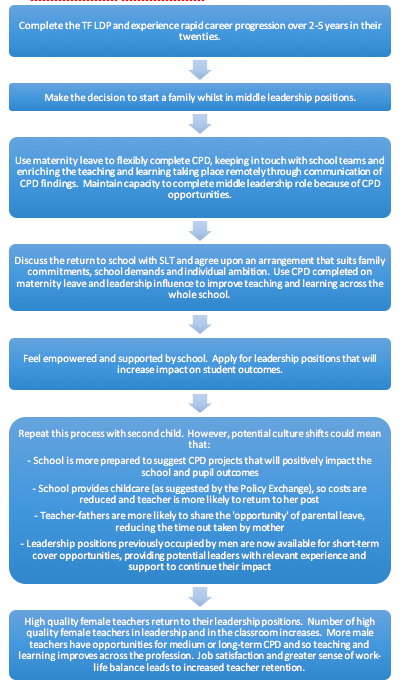
Figure B: an MTPT Project success story.
In the long term, The MTPT Project could also reduce the number of teachers leaving the profession permanently by offering an alternative solution to teachers wishing to start a family: rather than suffer the stress and disillusionment that is often the cause of poor teacher retention, shared parental leave could be maximised to provide an opportunity for teachers of both genders to step out of the classroom whilst continuing to develop skills and knowledge that will contribute positively to the teaching and learning, and leadership within ‘challenging’ schools where teacher burnout rate is high.


Sunday, 25 September 2016

Case Study: A Maternity Leave Masters

Jessica Carter (@JessoftheShire), primary school teacher and Mum of two, currently on maternity leave, explains how she has balanced her Masters with the Open University around her children and flexible working hours, and how the study has enriched her teaching and learning.


I'm currently part-way through a part-time MA in Childhood and Youth with the Open University. This will take three years in total (the recommended pace is 16 hours a week). The course is interdisciplinary and explores policy and practice in services for children and young people. I enrolled on the course after we moved back to the UK from overseas at the end of a teaching contract. I didn't feel ready to be back in the classroom, but I wanted to continue my professional development: to keep my brain firing on all cylinders whilst I immersed myself in the work of being a mum. It has always been a personal goal to work towards an MA, but it took time to find a course that really suited my interests and seemed worth the financial sacrifices.

When I began, my daughter was eight months old. My husband was working full-time but we lucky to have the support of both sets of grandparents and, at one year old, some time at a local nursery. One term later I also felt able to take on a part-time teaching post alongside the study and mum-time. In lots of ways it was the perfect balance for me: I benefited hugely from the flexibility of home study during my second pregnancy but, being a compartmentaliser, I struggled to fit study around newborn nap-times and toddler exuberance after the birth. The wonderful, flexible Open University were able to grant me a postponement and, now that my son is five months old I am thoroughly enjoying engaging with my studies again, with the continuing support of my tutor.

When my husband and I first had The Conversation (who would take what amount of leave) we were surprised to find that the traditional two-week paternity/long maternity leave model seemed the best fit for us. He was incredibly supportive of my MA and career development plans, despite the huge dip in household income it would entail: I fully appreciate that this is not an option available to everyone. For these 'baby years' he feels strongly that his priority is family: he wants to be able to come home for dinner, bath and bedtime each night without bringing work with him. Ironically, during the last few years he has been promoted twice while I am back on the lowest rungs of the pay scale with no leadership responsibilities. Research into the 'fatherhood bonus' versus the 'motherhood penalty' in the workplace certainly mirrors our experiences so far.


So what do I hope to get out of it? As well as reigniting my passion for education the course has opened my eyes regarding government policy and the importance of integration between services for children and young people. There is a strong emphasis on reflection on personal practice: the things I am learning can and have been immediately applied in the classroom and staffroom. It also promotes the view of teachers as active researchers, encouraging me to explore my potential impact on the profession and the wider field of children's services. I haven't enjoyed the temporary loss of income but I believe there will be a longer term benefit on the trajectory of my career, in terms of both financial and personal development.


Monday, 12 September 2016

Coaching + Baby


Today, baby and I went to our local family-friendly cafe (hub of NCT reunions and baby massage) to have a coffee with my former Teach First coach and have a coaching conversation about where on earth I'm going with my career and what I should work on to get there.

Coaching conversations are a great form of CPD for anyone, but particularly compatible with the #maternityteacher lifestyle because, other than the content of the conversation and the status of the coach, they are basically like meeting up with another mum or dad for a chat about things that interest you.  Coaching relationships are supportive and non-judgmental and because of this, any decent coach working with you to focus on your professional needs whilst on maternity leave will be understanding of the realities of having an 11 week old baby, and will do their utmost to make you feel comfortable and relaxed during the session.

Both a Google search and my own experience can attest to the manifold benefits of coaching, but it's important to understand the difference between a trained coach and a mate or well-meaning colleague who wants to help by giving you some sound advice.  If you don't have a convenient coach on hand, but have a network of people that you could call upon to provide you with informal coaching, make sure you consider the following before asking for a coaching conversation:

  • Does this person have both formal training in and experience of being a coach?  Even colleagues with experience of coaching can get the tone very wrong if they haven't had proper training from a reputable organisation - the line between coaching and mentoring is a fine one, and the subtle art of coaching requires fighting a lot of innate reactions in body language, tone of voice and semantics.  Whilst everyone has to have their first coachee after their formal training, you need to decide whether you are happy to be their pilot run at this stage, especially if your maternity leave is short - do you have the time to be offering this new coach more than they are able to offer you?
  • Can this person be objective?  Surprisingly, what makes my coach so effective is that he has never worked in education and is a man.  When I want to talk about school politics or whine about how tough it is to be a woman, what he doesn't do is roll his eyes and agree that there's always a Mr Smith or Mrs Jones in every staffroom, or pour me another glass of wine and agree that we should join forces to topple the patriarchy.  What he does is listen, ask objective questions and get me thinking clearly - he coaches.
  • Is this person available during the day?  It's a reality that the bath time routine starts at 7pm and if you're anything like me, you're dead to the world by 9pm (but sleepwalking through feeds and burping at midnight, 2am, 5am and ready to start the day again at 7am!)  Most people are only just finishing their commute at this time, so are unfortunately incompatible with your current lifestyle. 
  • Can this person commit to the timespan of your maternity leave?  If you're taking a full year or longer, make sure that this person can be around for a session at least three times a year.  If, like me, you're taking six months or less, you'll want to squeeze at least two sessions into this time, so it's important to arrange dates at the outset to which you can both commit.
  • Do you want this relationship to last beyond your maternity leave?  The focus of your conversations will depend on which ideas or areas of your career you want to resolve or develop through the coaching partnership.  If you'd like support with preparing now for the beginning of a new 5 year plan, for example, then your conversations will be different to those you might have if you want the coaching sessions to help you achieve a career goal within three months.
  • Try to keep it professional.  Let's be honest: your baby is gorgeous.  His smile lights up the room.  He is so clever and look, so alert and making lovely noises and can you see he's grabbing now and here, if I put him on his front he can show you how strong he's getting - he can lift up his head! ... Suddenly the coaching conversation is completely derailed.  It's difficult, but focus on yourself during your sessions, even if you bring baby with you.  It is highly likely that as you are standing up to go and your productive conversation is over, your coach will linger to coo and cheek-pinch and make all the right comments about how sparky your baby is - because who could resist?!
Now, what about the reverse to all of this?  I personally believe that everyone can benefit from effective coaching, but what if you already have a wealth of coaching experience and training?  How can you develop your leadership skills by continuing to coach others during your time off?  You might want to consider the support you can continue to give your school, or other teachers (a great opportunity to do so has been created by the DfE), but in this case, it's important to understand your coachee's expectations of your baby's attendance.  If you don't have the capacity to leave your baby with your partner, family member or childcare provider whilst you deliver coaching sessions for others, what about a creative arrangement between other teaching parents who also need to bring their children along?  If this is something with which you both feel comfortable and you can concentrate on each other, rather than your children, during the conversation, then it might be a workable solution.